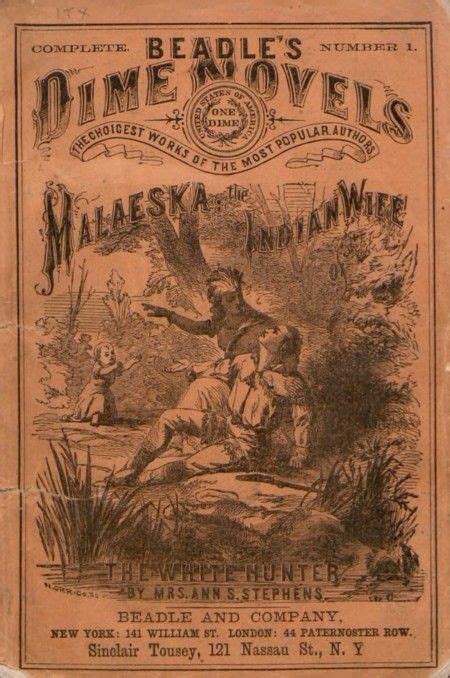
Although Malaeska was initially published serially in 1839 by “Ladies Companion” magazine, its republication by the Beadle brothers as the first of their “Beadle’s Dime Novels” series in 1860 made Ann Stephens literary history’s first dime novel author.
Much of Ann Stephens’s biography unfortunately seems lost to history. She was born in Derby, Connecticut on March 30, 1810. After marrying Edward Stephens in 1831, the couple moved up to Portland, Maine where together they would found “Portland Magazine,” a literary monthly. The couple had a son named Edward, Jr., who would go on to become a renowned NYC attorney, and one of his daughters was the actress Clara Lovegood. Much of Ann Stephens’s early work, including her first novel, Fashion and Famine, was published in “Portland Magazine.” Altogether she wrote over 25 serialized novels, in addition to an untold number of short stories and poems.
Malaeska, Indian Wife of the White Hunter was far and away Stephens’s most popular work – so popular, in fact, that it single-handedly started the dime novel trend. Malaeska reportedly sold more copies than Harriet Beecher Stowe’s more high-brow classic, Uncle Tom’s Cabin.
One factor that made Malaeska and the dime novel genre so incredibly popular was simply good timing. Published on the cusp of America’s Civil War, dime novels became a common way for soldiers to pass their down time. As battalions of troops moved about the country, soldiers would swap novels with one another so that the literature was being circulated fairly widely and rapidly for the era. Stories like Malaeska, about settler life on America’s frontiers, also had immense appeal at the time. As American colonists pushed the indigenous Americans further and further West, highly romanticized and heavily whitewashed tales of goldminers, cattle ranchers, and pioneers were not only highly popular, but also served as convenient propaganda to encourage westward expansion.
Malaeska itself is a rather simple story that could have used a more heavy-handed editor, in my humble and admittedly 21st-century opinion. Set in the Hudson Valley in the early 1600s, shortly after the arrival of the first Dutch settlers, it tells the tragic tale of Malaeska, an indigenous woman, and the child she has with a white colonist. Basically, the son is light-skinned enough to pass for white and, in accordance with his father’s dying wishes, is raised as a white Christian by his father’s family. The boy grows into a happy, handsome, successful young man who ends up committing suicide on the eve of his wedding because he learns that he’s biracial. The end. That’s the extent of the story. I’m going to optimistically assume that Stephens wrote the story with some kind of compassionate intent, but it is a little silly and a lot racist by today’s standards.
Below are links to web and PDF versions of Malaeska, Indian Wife of the White Hunter which I have annotated, as well as a link to the original text from Gutenberg.
- Annotated text – web version (Milanote app not required)
- Original text – Project Gutenberg
- Annotated text – PDF version:
 Library of Amazonia